

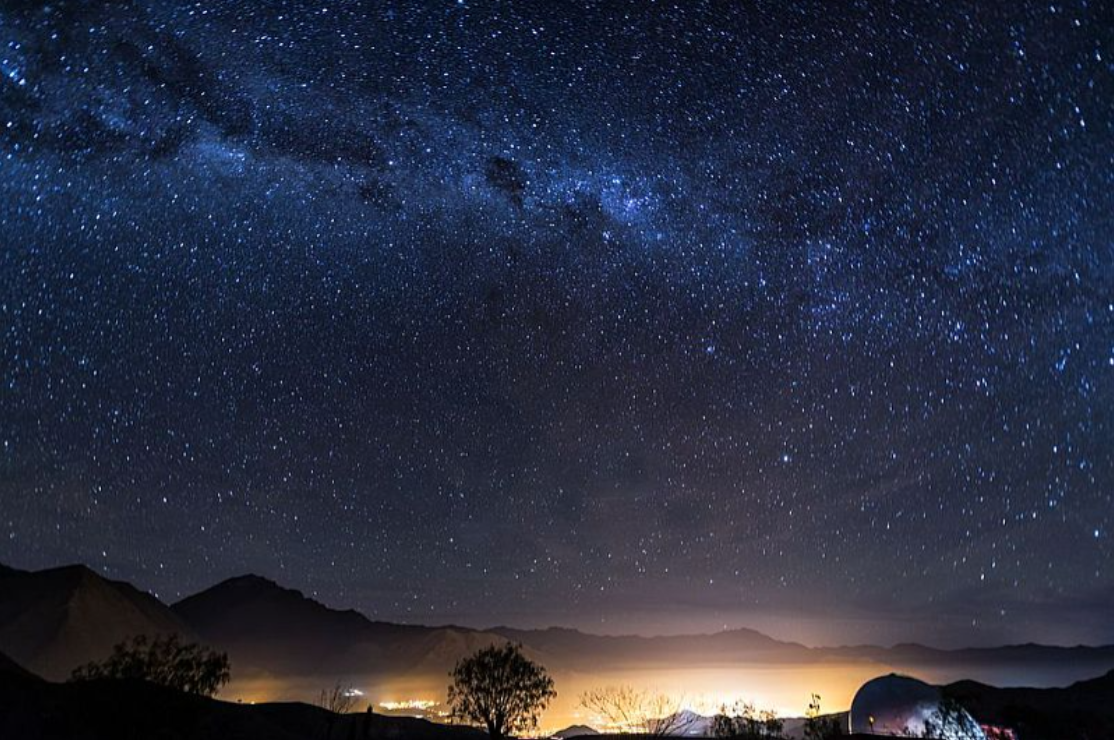
2026 has consolidated a historic transition: the sky is no longer just an object of contemplation, but a destination. While NASA’s Artemis II mission marks humanity’s return to the Moon’s vicinity—with its four-person crew performing a critical loop around the satellite—astronomical tourism on Earth has reached technical and commercial maturity.
Dark Sky Sanctuaries
The quest for total darkness has turned certain regions into “meccas” for photographers and scientists.
- Chile (Atacama & Elqui Valley): With over 300 clear nights a year, Chile remains the world capital. Points like San Pedro de Atacama offer an atmospheric transparency that allows the Milky Way to be seen with almost three-dimensional depth.
- Namibia (NamibRand Nature Reserve): In the heart of the world’s oldest desert, the total absence of light pollution allows for astrophotography experiences that seem surreal.
- Iceland: This year, the country is the epicenter for the Total Solar Eclipse of August 12, 2026. Reykjavik will be among the first to see the solar corona before the shadow crosses into Spain.
February 17: Annular Solar Eclipse (“Ring of Fire”)
- Best Visibility: Primarily Antarctica.
- Partial Visibility: Southern tip of South America (Chile and Argentina), Southern Africa, and parts of the Indian and Atlantic Oceans.
- What to expect: The Moon will be too far from Earth to completely cover the Sun, leaving a thin outer ring of light visible.
March 3: Total Lunar Eclipse (“Blood Moon”)
- Best Visibility: The Americas, Asia, Oceania, and Russia.
- What to expect: The Earth will pass directly between the Sun and the Moon. The Moon will take on a striking reddish-orange hue as it enters Earth’s dark shadow (the umbra).
August 12: Total Solar Eclipse
- Best Visibility: Iceland, Greenland, and Northern Spain.
- Partial Visibility: Most of Europe, Northern Africa, and parts of North America.
- What to expect: This is the big one—the first total solar eclipse visible from mainland Europe in 27 years. The Moon will completely block the Sun, revealing the solar corona.
From Tourist to Astronaut: Orbital Preparation
2026 is the year training becomes democratized. Companies like Axiom Space and Blue Origin have standardized protocols for civilians seeking stays on private stations like the future Orbital Reef.
- Ground Training: Programs now last just six months and include microgravity simulations and high-fidelity VR to familiarize guests with station modules.
- Suborbital Flights: Virgin Galactic has begun regular operations with its new Delta-class ships, offering 4 minutes of weightlessness and views of the Earth’s curvature.
Milestone 2026: The Launch of Luxury Space Hotels
The big news of the year is the official opening of reservations for the first luxury orbital hotels, projected for the end of the decade. Modules designed by Philippe Starck for Axiom promise padded walls with panoramic views of Earth (the “Cupola”), transforming a space stay from a survival mission into an aesthetic and sensory experience.”